| Label | Value |
|---|---|
| What Happened | Russia and Ukraine declared competing ceasefires in May 2026; broader peace talks remain stalled as fighting continues across multiple fronts. |
| When | Ongoing — key ceasefire events: May 5–9, 2026; latest battlefield reports: May 26–27, 2026 |
| Where | Eastern and southern Ukraine; Kyiv; diplomatic channels in Europe and the Middle East |
| Who | Presidents Zelenskyy (Ukraine), Putin (Russia), Trump (USA); NATO, EU, and European allies |
| Why It Matters | The war has entered a critical diplomatic phase, with competing ceasefires, Trump-backed negotiations, and nearly 1.36 million estimated Russian combat losses shaping a potential path toward — or away from — peace. |
| Source | Al Jazeera, Russia Matters / ISW, Ukrinform, Kyiv Independent (May 2026) |
Introduction
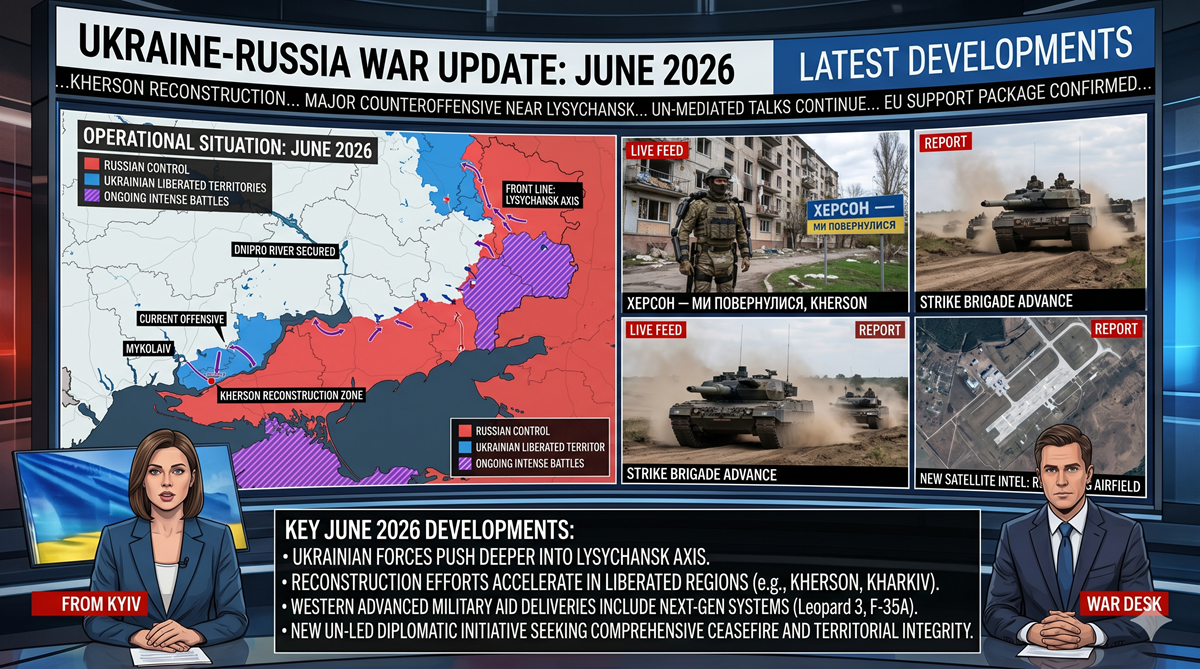
More than four years into Russia’s full-scale invasion, the Ukraine Russia war update for June 2026 paints a complex picture of a conflict caught between battlefield attrition and fragile diplomacy. In May 2026, Russia and Ukraine each declared their own ceasefires — on different days, for different reasons — without ever coordinating a shared pause in fighting. Meanwhile, US President Donald Trump announced a short three-day ceasefire window, calling it potentially “the beginning of the end” of the war. But on the ground, missiles continued to fly, drones continued to fall on civilian areas, and peace remained stubbornly out of reach. This article covers the most important developments from the past weeks and looks at what the coming months could hold for both nations — and for the world watching closely.
Background & Context
Russia launched its full-scale invasion of Ukraine on February 24, 2022. What Moscow expected to be a rapid military operation instead became one of the longest and costliest conflicts in modern European history. By May 2026, Russian combat losses had climbed to an estimated 1.36 million personnel, according to Ukrainian military tracking data. Russia currently controls approximately 20% of Ukrainian territory — roughly the size of the US state of Pennsylvania — though ISW data shows that in the April–May 2026 period, Russian forces actually suffered a net territorial loss of 69 square miles.
Diplomatic efforts have gathered pace in 2026, following a rocky but significant year of back-channel contacts. Direct talks between Russia and Ukraine were held in Istanbul in May 2025 — the first such meeting since March 2022 — but they ended in under two hours with no ceasefire agreement. Both sides did agree to a large prisoner-of-war exchange of 1,000 personnel each, signaling some willingness to engage. Since then, negotiations have continued in fits and starts, with the United States increasingly taking a hands-on mediation role under Trump, whose administration has pushed hard for a deal.
Key Developments in the Ukraine Russia War: May–June 2026
1. Competing Ceasefires and the Trump Factor
One of the most striking aspects of the Ukraine Russia war update in recent weeks has been the emergence of rival ceasefire declarations. Russia announced a unilateral ceasefire for May 8–9, coinciding with its Victory Day military parade in Moscow — a politically symbolic moment for the Kremlin. Ukraine, rather than accepting Russia’s terms, declared its own separate ceasefire for May 5–6. The two announcements, timed differently and driven by separate political agendas, underscored just how far apart the two sides remain.
In between, President Trump announced a US-backed three-day ceasefire and expressed hope it would be extended, saying talks were getting “closer and closer every day.” The Kremlin, however, was measured in its response. Kremlin spokesman Dmitry Peskov cautioned that reaching a settlement was “a very long way with complex details.” Despite the diplomatic flurry, armed engagements and drone attacks continued throughout this period.
2. Frontline Situation and Battlefield Reality
On the ground, the war continues with grinding intensity. Russia has been launching regular waves of drone and missile strikes on Ukrainian cities. A major Russian attack on Kyiv on May 24, 2026 killed at least three people, according to Ukrainian authorities. Ukrainian forces, meanwhile, have been striking back — the Syzran oil refinery in Russia halted operations after a Ukrainian drone strike on May 21. Ukrainian units also destroyed Russian military equipment in the Sloviansk sector in eastern Ukraine.
Foreign fighters are playing an increasingly significant role in the conflict. As of May 2026, at least 2,965 citizens from 36 African countries have served or are currently serving in the Russian military, with Moscow reportedly planning to recruit 18,500 foreign fighters over the course of the year. North Korean troops, deployed to Russian-held areas in late 2024, have continued to play a role, particularly in the Kursk border region.
3. Putin’s Peace Signals and the Diplomatic Chessboard
After Victory Day events in Moscow on May 9, President Putin made an unexpected public statement hinting that Russia’s war in Ukraine may be “coming to an end,” and expressed readiness to hold direct talks with President Zelenskyy — either in Moscow or a neutral country. Putin again blamed the West for prolonging the conflict through military support to Ukraine. Analysts remain cautious about reading too much into these signals, noting that Russia has made similar overtures before while simultaneously ramping up attacks. Trump and Zelenskyy have reportedly agreed on 90 to 95 percent of a peace proposal, according to the Atlantic Council, though key sticking points remain unresolved.
📌 Key Points Summary
- Russia and Ukraine each declared separate, uncoordinated ceasefires in May 2026, reflecting deep mutual distrust and political posturing on both sides.
- A US-backed three-day ceasefire was announced by President Trump, who called it potentially the start of the end of the war, though the Kremlin urged caution.
- Russian combat losses have reached an estimated 1.36 million personnel since February 2022, while Russia controls roughly 20% of Ukrainian territory.
- Ukraine struck a Russian oil refinery with drones, while Russia launched deadly missile attacks on Kyiv and continued bombardment across multiple front sectors.
- Diplomatic contacts continue, with Trump and Zelenskyy reportedly close to agreeing on a peace framework, though a final deal remains elusive.
Impact & Analysis
The situation heading into June 2026 points to a war entering a new, uncertain phase. In the short term, the competing ceasefire declarations and US-mediated talks suggest that diplomacy is now at least on the table in a more serious way than it has been at any point since 2022. However, the absence of a durable, mutually agreed halt to hostilities means civilians on both sides — particularly in Ukraine — continue to bear an immense cost. Russia’s ongoing recruitment of foreign fighters and continued missile campaigns indicate that Moscow has not abandoned its military objectives.
Over the longer term, Europe faces mounting pressure to take a greater role in both defending Ukraine and guaranteeing any future peace agreement. The Atlantic Council has noted that European reluctance to fully fund Ukraine’s defense is shortsighted — if Russia’s invasion ultimately succeeds, the cost to European security would far exceed what backing Ukraine now requires. Ukraine’s energy infrastructure, already severely degraded (with nearly half of pre-war generating capacity destroyed or damaged), will require massive international investment regardless of how the war ends.
People Are Also Asking
❓ Is there currently a ceasefire in the Ukraine Russia war?
As of late May 2026, there is no lasting, mutual ceasefire in effect. Both sides declared brief, separate ceasefires in early May, and a short US-backed pause was announced, but armed engagements and strikes have continued. Negotiations are ongoing but a formal agreement has not been reached.
❓ How much territory does Russia control in Ukraine as of 2026?
Russia currently occupies approximately 20% of Ukrainian territory, an area roughly equivalent to the US state of Pennsylvania. However, ISW data from April–May 2026 indicates that Russian forces actually recorded a net loss of around 69 square miles during that period, suggesting Ukrainian resistance has slowed Moscow’s advances.
❓ What role is the United States playing in Ukraine Russia peace talks?
Under President Trump, the US has taken an active mediation role, brokering short ceasefires and facilitating direct communication between the two sides. Trump has stated that he and Zelenskyy have agreed on the vast majority of a peace proposal, and his administration has pushed for direct Russia-Ukraine negotiations, though substantial disagreements remain.
❓ How many Russian soldiers have been lost in the Ukraine war?
According to Ukrainian military tracking figures, total Russian combat losses from February 2022 through late May 2026 have reached an estimated 1.36 million personnel, including killed and wounded. These figures are provided by Ukrainian sources and have not been independently verified; Russia does not publicly disclose its casualty numbers.
Conclusion
The Ukraine Russia war update heading into June 2026 reflects a conflict at a crossroads. Competing ceasefires, a US-led diplomatic push, and the sheer exhaustion of four years of full-scale warfare are all converging at the same time. Putin has hinted at an openness to end the war; Zelenskyy has indicated readiness to negotiate — yet the bombs and drones continue to fly. The path to a durable peace remains narrow and complicated, but it is no longer entirely invisible. For ordinary Ukrainians living under bombardment and for Russian families counting their losses, the hope — fragile as it is — matters enormously.
Stay informed as this situation continues to evolve rapidly. If you found this article helpful, consider sharing it with others who are following the conflict. Leave a comment below with your thoughts on where the war and peace talks are headed.
This article is for informational purposes only. It does not represent political opinion or advocacy for any party in the conflict.
Sources: Al Jazeera, Kyiv Independent, Ukrinform, Russia Matters / Institute for the Study of War (ISW), Atlantic Council — reporting as of May 26–27, 2026.
Related Internal Links
- Samsung Galaxy S26 Review: Is It Worth Buying in 2026?
- Bitcoin Price Prediction June 2026: Will BTC Rally?
- Apple WWDC 2026: Biggest Announcements You Need to Know
- FIFA World Cup 2026 Host Cities: Complete Fan Guide