
Canada’s provincial vaccination schedule is the official immunization timetable each province and territory publishes to guide parents on which vaccines their children need and when. The Public Health Agency of Canada (PHAC) maintains a national reference that consolidates these schedules, while the Canadian Immunization Committee (CIC) advises on evidence-based recommendations. To use provincial vaccination schedule Canada resources correctly, parents must first identify their specific province or territory, then match their child’s age to the relevant vaccines and doses listed. Catch-up schedules are also available for children who have missed doses, removing the need to restart any series from scratch.
How to use provincial vaccination schedules in Canada
Every province and territory in Canada operates its own immunization program, adapted from national guidance provided by the National Advisory Committee on Immunization (NACI). NACI provides guidance that provinces then adapt according to regional needs, which explains why schedules differ across the country. A child in British Columbia may receive a vaccine at a different age than a child in Nova Scotia, even though both schedules are grounded in the same national evidence base.

PHAC publishes a central reference page that organizes province-specific vaccine schedules by vaccine antigen and by province or territory. This means you will not find a single unified calendar showing every vaccine at every age. Instead, the tables list each vaccine across the top and each province down the side, with dose timing filled in for each cell. Parents are recommended to first identify their province, then scan the relevant vaccines for their child’s current age.
The core vaccines covered in most provincial schedules include DTaP (diphtheria, tetanus, pertussis), MMR (measles, mumps, rubella), varicella, Hib, hepatitis B, meningococcal, pneumococcal, and HPV. Influenza vaccine is also listed in most schedules, though eligibility and program details vary. The table below shows a simplified comparison of selected vaccine timing across four provinces.
| Vaccine | Ontario | British Columbia | Alberta | Quebec |
|---|---|---|---|---|
| DTaP (first dose) | 2 months | 2 months | 2 months | 2 months |
| MMR (first dose) | 12 months | 12 months | 12 months | 12 months |
| HPV (first dose) | Grade 7 | Grade 6 | Grade 5 | Grade 4 |
| Meningococcal C | 12 months | 12 months | 12 months | 18 months |
| Varicella | 15 months | 12 months | 12 months | 18 months |
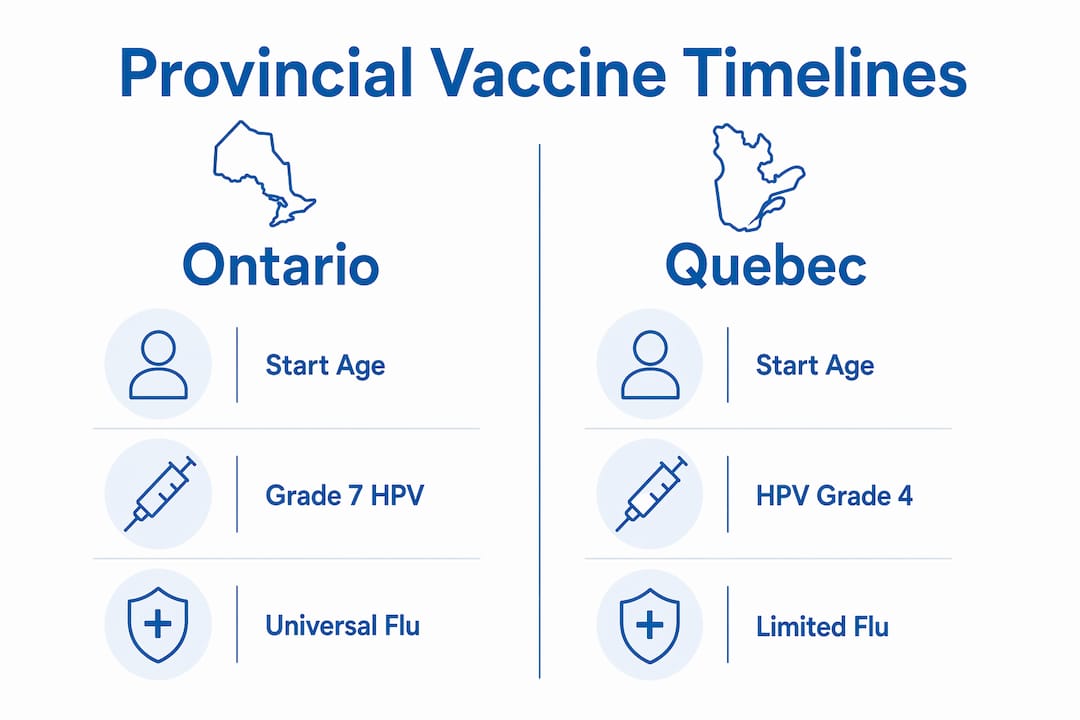
HPV timing is one of the clearest examples of provincial variation. Ontario starts the program in Grade 7, while Quebec begins in Grade 4. This difference does not reflect a disagreement on safety or effectiveness. It reflects local program design decisions made by each province’s chief medical officer.
How do you access and interpret your child’s schedule?
Accessing the correct schedule requires two steps. First, go to the PHAC immunization hub, which centralizes links to all provincial and territorial schedules alongside parent-friendly guidance on vaccine records and side effects. Second, navigate to your specific province’s health authority website for the most current local version, since provincial pages are updated more frequently than the national summary.
Interpreting the tables is where many parents get stuck. PHAC tables are organized by vaccine antigen and province, which means you must read across rows and down columns rather than following a simple age-based list. The practical approach is to write down your child’s current age, then go row by row through the table and flag every vaccine that shows a dose due at or near that age for your province.
Here is a step-by-step process to follow:
- Identify your province or territory. Open the PHAC provincial schedule page and locate your jurisdiction in the table.
- Note your child’s current age. Cross-reference the age columns for each vaccine row that applies to your province.
- List every vaccine with a dose due. Write down the vaccine name, dose number, and recommended age range.
- Check your child’s immunization record. Compare the list against what has already been given. Most provinces issue a yellow immunization card or digital record at birth.
- Book an appointment with your health care provider. Bring the record and the list. Your provider will confirm what is due and what may need a catch-up plan.
Pro Tip: Several provinces offer digital immunization record tools. Ontario’s CANImmunize app and British Columbia’s ImmunizeBC app both allow parents to track doses, set reminders, and generate printable records. These tools do not replace your official health record but make day-to-day tracking much easier.
Keeping a physical copy of your child’s immunization record is still the most reliable backup. School enrollment and travel often require documented proof of vaccination, and digital systems can have access issues during transitions between health authorities.
What happens if your child missed vaccination doses?
Missing a scheduled dose does not mean starting over. The Canadian Immunization Guide states clearly that interruptions to an immunization series generally do not require restarting. The child simply continues from where the series was interrupted, using a catch-up schedule appropriate for their current age.
This is one of the most misunderstood points in Canada vaccination guidelines. Many parents assume a missed dose at 4 months means the entire DTaP series must restart. That assumption is incorrect. Catch-up scheduling allows the series to be completed based on the child’s current age and the doses already received, avoiding unnecessary repeat vaccinations while still completing immunity.
Key points about catch-up immunization in Canada:
- Health professionals assess vaccine history first. Your provider reviews what doses were given, at what ages, and calculates the minimum intervals needed before the next dose.
- Minimum intervals still apply. Even in catch-up mode, doses cannot be given too close together. The Canadian Immunization Guide specifies minimum intervals for each vaccine.
- Some vaccines have age cutoffs. Certain vaccines, such as rotavirus, have maximum age limits beyond which they are no longer recommended. Catch-up is not always possible for every vaccine.
- Provincial catch-up schedules are available. PHAC’s provincial catch-up tables list recommended timing for children who are behind, organized by province.
Catch-up scheduling flexibility removes the stress of missed doses, reassuring families they can still fully protect their children with age-appropriate vaccination. The key is acting promptly once you identify the gap.
Pro Tip: If your child has an incomplete or lost immunization record, your health care provider can check provincial immunization registries. Most provinces maintain electronic records that can reconstruct a child’s vaccine history even if the paper card is missing.
What are province-specific vaccine programs beyond the routine schedule?
Beyond the standard childhood vaccines, several provinces run additional programs targeting specific populations or seasonal risks. These programs represent extra layers of protection and have their own eligibility criteria that parents must verify separately.
Ontario’s Universal Influenza Immunization Program is one of the most well-known examples. Ontario provides free influenza vaccine annually to all residents 6 months and older. No health card is required, though proof of Ontario residency may be requested. This program runs each fall, typically from October through March, and covers children who are not yet old enough for some other vaccines on the routine schedule.
RSV protection programs are a more recent addition in several provinces. Saskatchewan, Manitoba, and Ontario have targeted RSV monoclonal antibody programs for infants during RSV season. These programs are not traditional vaccines but offer protection against respiratory syncytial virus, which causes serious illness in young infants. Eligibility is typically limited to infants born within a specific window before or during RSV season, and criteria differ by province.
| Program | Province | Eligibility | Season |
|---|---|---|---|
| Universal Influenza | Ontario | Residents 6 months and older | October to March |
| RSV Monoclonal Antibody | Ontario, Manitoba, Saskatchewan | Infants meeting age/risk criteria | Fall/Winter |
| School-based HPV | All provinces | Grade varies by province | School year |
| Meningococcal ACYW | Several provinces | Adolescents, varies by age | Year-round |
Parents should contact their local public health unit directly to confirm current eligibility for any special program. Provincial health websites update eligibility criteria annually, and programs can change based on vaccine supply and public health priorities.
Key takeaways
Following your province’s official immunization schedule is the single most reliable way to protect your child from vaccine-preventable diseases on time and in the correct sequence.
| Point | Details |
|---|---|
| Use your province’s schedule | PHAC tables are organized by province and vaccine, not by a single national age calendar. |
| Missed doses do not restart the series | The Canadian Immunization Guide confirms catch-up schedules complete remaining doses based on current age. |
| Province-specific programs exist | Ontario, Manitoba, and Saskatchewan run RSV and influenza programs with separate eligibility criteria. |
| Keep an updated immunization record | Schools, travel, and health transitions all require documented proof of vaccination history. |
| Consult your health provider for catch-up | Providers use vaccine history and minimum intervals to build a personalized catch-up plan. |
Why reading the schedule yourself is worth the effort
I have spent years reviewing health information resources for Canadian families, and the provincial vaccination schedule is one of the most underused tools available to parents. Most families rely entirely on their doctor’s office to prompt them when vaccines are due. That works well in routine circumstances, but it breaks down when families move between provinces, change health care providers, or experience gaps in care.
The PHAC tables look intimidating at first. They are organized by antigen, not by age, which is the opposite of what most parents expect. Once you understand that structure, the tables become genuinely useful. You can check at any point whether your child is on track, identify gaps before they become problems, and walk into appointments with specific questions rather than vague concerns.
The catch-up schedule information is particularly valuable. Parents who discover their child missed a dose often assume significant harm has been done or that the entire process must restart. Neither is true. The flexibility built into Canadian immunization guidelines exists precisely because real life is unpredictable. Knowing that catch-up is straightforward removes a significant source of parental anxiety.
My practical advice: download or bookmark your province’s current schedule, keep a copy of your child’s immunization record in both digital and paper form, and review the schedule at every birthday. One annual check takes less than ten minutes and keeps you fully informed.
— nick
Staying informed about your child’s health

Vaccination is one part of a broader picture of child health. At Healthydietreviews, you will find expert guidance on family nutrition, wellness planning, and health management that complements your child’s immunization schedule. Whether you are tracking developmental milestones, planning a balanced diet for growing children, or looking for credible health information, Healthydietreviews brings together practical resources for Canadian families. Keeping your child healthy means staying current on both preventive care like vaccines and the daily nutrition and lifestyle choices that support long-term wellbeing.
FAQ
What is a provincial vaccination schedule in Canada?
A provincial vaccination schedule is the official list of vaccines recommended for children in a specific province or territory, including the ages and doses at which each vaccine should be given. PHAC publishes a national summary table, but each province manages its own program with local variations.
How do I find the vaccination schedule for my province?
Go to the PHAC immunization hub at Canada.ca, which links directly to each province and territory’s routine and catch-up vaccination schedule. You can also visit your provincial health authority’s website for the most current local version.
Does my child need to restart vaccines if they missed a dose?
No. The Canadian Immunization Guide confirms that missed doses do not require restarting the series. Your health care provider will use a catch-up schedule based on your child’s current age and vaccine history to complete the remaining doses.
Why do vaccination schedules differ between provinces?
NACI provides national evidence-based recommendations, but each province adapts those recommendations to local public health priorities, program capacity, and population needs. This explains differences in timing for vaccines like HPV and meningococcal across provinces.
Are there vaccines available beyond the routine childhood schedule?
Yes. Several provinces run additional programs such as Ontario’s Universal Influenza Immunization Program for residents 6 months and older, and RSV monoclonal antibody programs in Ontario, Manitoba, and Saskatchewan targeting infants during RSV season. Eligibility criteria vary and are updated annually.
Article generated by BabyLoveGrowth
Related Internal Links
- Medicinal Garden Kit Review 2026: My Honest Take
- Blood Sugar Blaster 2026: 3-month results – Did it help?
- Prime Perform Reviews 2026: Does it Deliver?
- GlucoTonic Reviews 2026