Eid al-Adha 2026: Date, Significance & Celebrations
| 📅 Key Facts: Eid ul-Adha 2026 | |
|---|---|
| What Happened | Eid ul-Adha 2026 confirmed for Wednesday, May 27 following official crescent moon sighting |
| When | Wednesday, May 27, 2026 (10th of Dhul Hijjah, 1447 AH) — celebrations run May 27–29 |
| Where | Observed globally — Saudi Arabia, Pakistan, UAE, UK, USA, Bangladesh, and 50+ countries |
| Who | Approximately 1.8 billion Muslims worldwide |
| Why It Matters | Eid ul-Adha is the holiest of the two major Islamic festivals, commemorating Prophet Ibrahim’s supreme act of faith and coinciding with the annual Hajj pilgrimage |
| Source | Saudi Arabia Supreme Court; Pakistan Central Ruet-e-Hilal Committee; UAE Council for Fatwa |
Introduction
Every year, more than 1.8 billion Muslims around the world look forward to one of the most spiritually profound celebrations in the Islamic calendar — Eid ul-Adha 2026. This year, the Festival of Sacrifice falls on Wednesday, May 27, 2026, corresponding to the 10th of Dhul Hijjah, 1447 AH. The date was confirmed after official moon-sighting authorities in Saudi Arabia, Pakistan, and the UAE verified the crescent of Dhul Hijjah on May 17, 2026, establishing May 18 as the first day of the sacred month. Whether you are preparing for Qurbani, planning family gatherings, or simply want to understand why this occasion carries such enormous meaning, this article covers everything you need to know — from its deep religious roots to the vibrant ways it is observed across the globe.
Background & Context
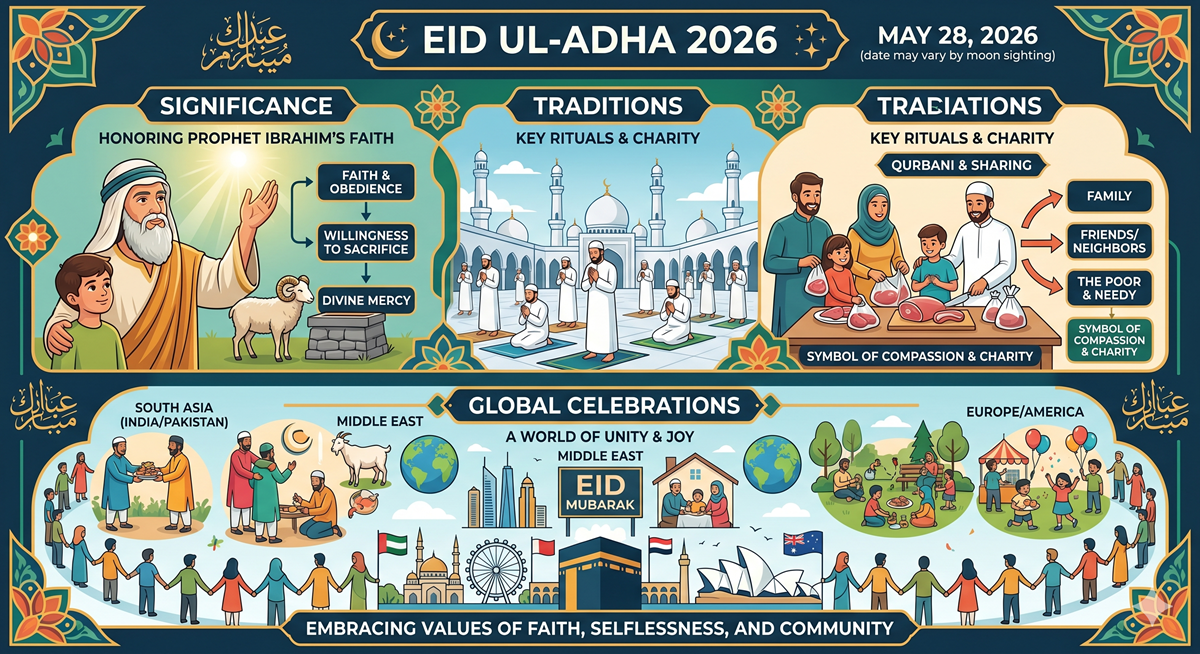
Eid ul-Adha — also known as Bakra Eid, Eid al-Kabir (the Greater Eid), or the Festival of Sacrifice — has been observed by Muslims for over fourteen centuries. Its origins trace back to a pivotal moment recorded in the Quran (Surah As-Saffat, 37:102): Prophet Ibrahim (AS) received a divine command to sacrifice his beloved son, Prophet Ismail (AS). In a remarkable demonstration of unquestioning faith, Ibrahim prepared to comply. At that critical moment, Allah replaced Ismail with a ram, accepting the spirit of the sacrifice and sparing the son. This act of absolute submission became the foundation of an annual observance that Muslims carry forward to this day.
The Islamic calendar is entirely lunar, meaning Eid ul-Adha shifts approximately 10 to 11 days earlier each solar year. In 2025, the festival fell on June 6; in 2026, it arrives on May 27. This gradual movement through the seasons means that over a 33-year cycle, Muslims observe Eid ul-Adha in every season — summer, autumn, winter, and spring. The 2026 celebration also coincides closely with the conclusion of Hajj, the annual pilgrimage to Mecca that is one of Islam’s five pillars, making this an especially charged period for the global Muslim community.
Understanding Eid ul-Adha 2026 in Depth
The Confirmed Date and the Moon Sighting Process
The official date of Eid ul-Adha cannot be set arbitrarily — it depends entirely on the physical sighting of the Dhul Hijjah crescent moon. On Sunday, May 17, 2026, astronomical bodies and judicial courts across major Muslim countries conducted official sky observations. The crescent was confirmed, establishing Monday, May 18, 2026 as the 1st of Dhul Hijjah 1447 AH. Counting forward to the 10th day of the month places Eid ul-Adha squarely on Wednesday, May 27, 2026. The Day of Arafah — the most sacred day of Hajj, when pilgrims gather at the plain of Arafat to supplicate — falls on Tuesday, May 26. The three days of Eid itself run from May 27 through May 29 in most countries.
It is worth noting that due to local atmospheric conditions and regional horizon calculations, some countries such as India and Bangladesh may observe Eid a day later on Thursday, May 28, 2026. Muslims in these regions follow their own national moon-sighting committees, and announcements are typically made the evening before Eid.
The Significance of Qurbani: More Than a Ritual
The defining act of Eid ul-Adha is the Qurbani — the ritual sacrifice of a livestock animal such as a goat, sheep, cow, or camel. Islamic scholars cite multiple hadiths emphasizing the importance of this act for those who can afford it. One hadith recorded in Sunan Ibn Majah quotes the Prophet (PBUH) as saying that the sacrifice is deeply beloved to Allah on this day, and that the animal’s blood reaches Allah before it touches the ground. The meat from the sacrifice is divided into three equal portions: one third is kept by the family, one third is shared with relatives and neighbors, and one third is donated to those in need. This division ensures that even the poorest members of the community share in the joy of the feast.
In the modern era, Qurbani has also gone digital. Numerous Islamic charities and organizations now offer online Qurbani services, allowing Muslims living in Western countries to donate the cost of a sacrifice and have it performed on their behalf in countries where the meat is most needed — including parts of South Asia, Sub-Saharan Africa, and the Middle East. This has broadened the reach of the tradition and ensured that the act of charity remains central even when physical sacrifice is not possible.
Global Celebrations: How Muslims Observe Eid ul-Adha
While the spiritual core of Eid ul-Adha is consistent worldwide, the cultural expressions vary beautifully across regions. In Saudi Arabia, millions of pilgrims who have just completed the Hajj descend from Mina after performing their own sacrifice near Mecca. Streets are festive, families reunite, and an atmosphere of spiritual renewal fills the air. In Pakistan and Bangladesh, livestock markets bustling with activity in the days before Eid are a familiar sight — families purchase their Qurbani animals days in advance, and the morning of Eid begins with the men attending congregational prayers at mosques and open grounds, followed by the sacrifice. In Turkey, the holiday is called Kurban Bayramı, and it is a national public holiday lasting four days. In Indonesia, the world’s most populous Muslim-majority country, Eid prayers are held at dawn in open fields, with massive congregations that sometimes number in the hundreds of thousands. In Western countries such as the UK, USA, and Canada, Muslim communities gather at Islamic centers and rented halls or stadiums for Eid prayers, after which families celebrate with traditional meals and social visits.
🌙 Key Points: Eid ul-Adha 2026 at a Glance
- Eid ul-Adha 2026 is confirmed for Wednesday, May 27, 2026 in Saudi Arabia, Pakistan, UAE, UK, and the USA, with some countries such as Bangladesh and India observing it on May 28.
- The holiday marks the 10th of Dhul Hijjah, 1447 AH, and commemorates Prophet Ibrahim’s willingness to sacrifice his son Ismail in obedience to Allah’s command.
- The central act of worship is the Qurbani (animal sacrifice), with the meat distributed equally among family, neighbors, and those in need.
- The Day of Arafah — the holiest day in the Islamic calendar — falls on Tuesday, May 26, 2026, one day before Eid.
- Eid ul-Adha is celebrated by approximately 1.8 billion Muslims globally and is recognized as a public holiday in over 70 countries.
Impact & Analysis
Eid ul-Adha has ripple effects that extend well beyond individual households. Economically, the days surrounding the festival drive significant consumer activity across Muslim-majority nations. Livestock markets, food suppliers, clothing retailers, and travel services all see surges in demand during this period. In countries like Pakistan and Bangladesh, billions of rupees and taka change hands in the weeks leading up to the holiday as families purchase animals for Qurbani. Airlines and bus services run at capacity as people return to their hometowns.
From a humanitarian standpoint, the Qurbani tradition channels a substantial flow of protein-rich food to vulnerable communities across the developing world. Islamic relief organizations coordinate large-scale sacrifice campaigns in some of the world’s most food-insecure regions, making Eid ul-Adha one of the largest single annual food distribution events on the planet. In the longer term, the values embedded in this occasion — sacrifice, generosity, community solidarity, and submission to a higher moral purpose — serve as a powerful annual reminder for Muslims to prioritize others in their daily lives, not just on Eid.
People Are Also Asking
Conclusion
Eid ul-Adha 2026 is a moment of deep spiritual reflection, communal generosity, and joyful celebration for Muslims across every continent. With the date officially confirmed as Wednesday, May 27, 2026 by major Islamic authorities worldwide, families can now plan their Qurbani, prayers, and gatherings with full confidence. Whether you are attending Eid prayer at a local mosque, arranging a Qurbani sacrifice, donating through a charity on behalf of those in need, or simply joining loved ones for a festive meal, the essence of this occasion remains the same: a reminder to put faith above all else and to share your blessings with those around you. Eid Mubarak to all who are celebrating — may this Eid bring peace, unity, and joy to every home.
Found this article helpful? Share it with family and friends, and feel free to leave your Eid wishes and comments below.
Disclaimer: This article is for informational purposes only. Exact dates for Islamic observances are subject to official moon-sighting announcements by relevant religious authorities in each country and may vary by one day.
Sources: Islamic Relief UK; IslamicFinder; Muslim Pro; Human Relief Foundation; Saudi Arabia Supreme Court; Pakistan Central Ruet-e-Hilal Committee; UAE Council for Fatwa.
Related Internal Links
- US Gas Price Hits $4.56 — How to Save Money on Fuel in 2026
- US Inflation Rate April 2026: What It Means for You
- Best Dividend Stocks to Buy in June 2026
- Ukraine Russia War Update June 2026: Latest Developments