Gold Price Forecast 2026: Should You Invest Now?
| Label | Value |
|---|---|
| Topic | Gold price outlook and investment case for 2026 |
| Key Figures | Current price ~$4,562/oz; bank targets range $4,400–$6,300/oz |
| Who It Affects | Individual investors, portfolio managers, central banks, ETF holders |
| Time Period | Full-year 2026; with reference to 2025 historic run |
| Bottom Line | Gold remains a strong defensive asset in 2026, backed by central bank demand, inflation concerns, and geopolitical uncertainty |
Introduction
Gold has done something remarkable in recent years: it has stopped behaving like a quiet, boring hedge and started making headlines. The gold price forecast for 2026 is one of the most-searched investment topics right now — and for good reason. Gold entered 2026 trading near $5,000 per ounce after a stunning rally through 2025, briefly touching an all-time high of $5,589 in late January. Since then, prices have pulled back to around $4,562 as of late May 2026, creating a genuine question for investors: is this a buying opportunity or a warning sign?
This article breaks down what the world’s top financial institutions are forecasting, what forces are driving gold prices right now, and whether adding gold to your portfolio makes sense in the current environment. Whether you’re a first-time investor or a seasoned portfolio manager, the data here will help you make a more informed decision.
Background: How Gold Got Here
To understand where gold is going, it helps to know where it has been. At the start of 2025, institutional consensus placed gold somewhere in the $2,800–$3,200 per ounce range. That forecast proved wildly conservative. A combination of persistent inflation, central bank reserve diversification, a weaker US dollar, and escalating geopolitical tensions drove gold on one of its most powerful bull runs in modern history — delivering a year-on-year gain of nearly 40%.
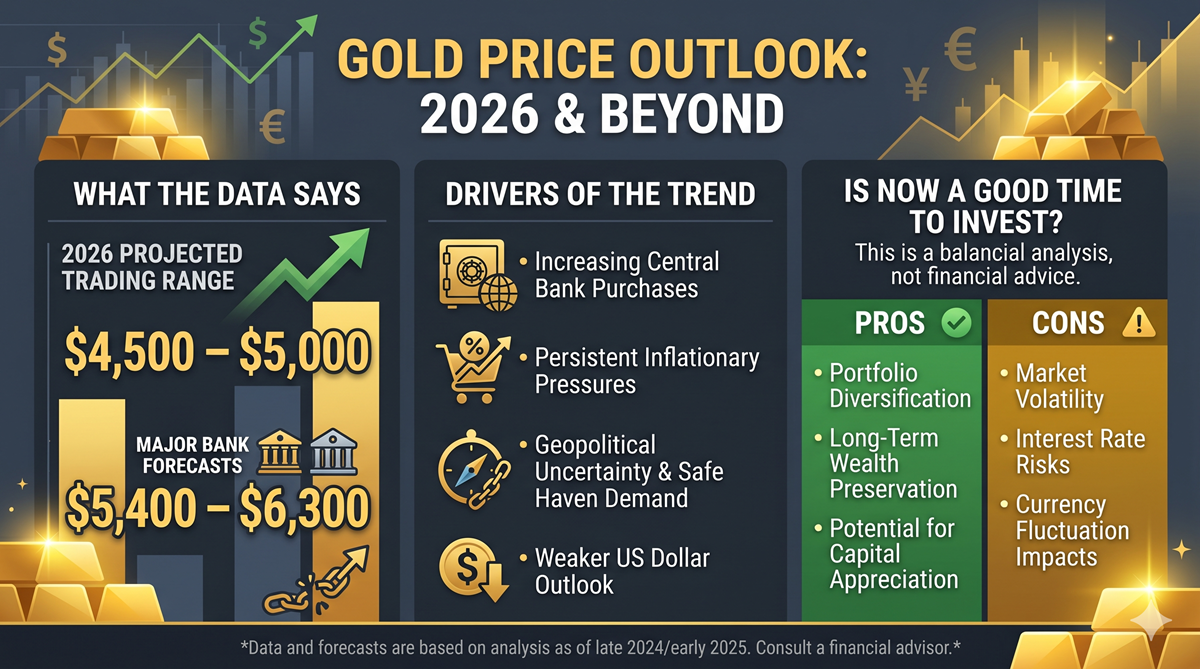
Critically, the drivers behind this rally are not short-term noise. Central banks in China, India, Russia, Poland, and Turkey have been accumulating gold at roughly 800 tonnes per year, adding a structural layer of demand that is largely independent of retail investor sentiment. At the same time, growing concerns about US fiscal deficits and the long-term value of paper currencies have pushed more institutional investors toward gold as a reserve asset. That backdrop — not mere speculation — is what major banks are pricing into their 2026 gold forecasts
.
What the Experts Are Saying
Major Bank Price Targets for 2026
The range of bank forecasts for gold in 2026 is unusually wide, reflecting genuine disagreement about how far this bull run has to go. On the bullish end, J.P. Morgan projects gold reaching $6,300 per ounce by year-end, while Wells Fargo and BNP Paribas both see $6,000–$6,300 as achievable. Goldman Sachs has set a target of $5,400. TD Securities has raised its average annual price estimate to $4,831, with a trading high of $5,400 expected in the first half of the year. More conservative analysts put fair value closer to $4,400, reflecting the view that current prices already embed a lot of good news.
The World Gold Council — which rarely issues specific price targets — laid out three scenarios in its 2026 Gold Outlook: a mild cooling scenario pointing to 5–15% price growth, a global recession and geopolitical shock scenario forecasting 15–30% gains, and a stronger-dollar / higher-yield scenario where gold faces headwinds. The base case leans toward moderate upside from current levels, not a dramatic crash.
What’s Driving the 2026 Gold Price
Several forces are at work simultaneously. First, central bank buying continues to provide a consistent demand floor that retail investors cannot easily replicate. Second, concerns about US fiscal policy and growing government debt loads are prompting more institutions to diversify away from dollar-denominated assets. Third, the Federal Reserve’s rate-cutting cycle has reduced the “opportunity cost” of holding gold — when interest rates fall, bonds and savings accounts become less attractive relative to a non-yielding asset like gold.
ETF inflows have also picked up meaningfully in 2026, signaling that retail and institutional investors who sat on the sidelines during the 2025 rally are now re-engaging. This incremental demand, layered on top of existing central bank purchases, is what most bullish analysts are counting on to push prices toward the higher end of the forecast range.
The Risks: What Could Push Gold Lower
No gold forecast is complete without an honest look at the downside risks. The most significant threat to the bull case is a hawkish shift from the Federal Reserve — if inflation re-accelerates and forces rate hikes back onto the table, real yields would rise and the US dollar would likely strengthen, both of which are direct headwinds for gold prices. A sustained dollar rally is the single most reliable short-term pressure on gold. Geopolitical de-escalation — say, a credible resolution to ongoing international conflicts — could also reduce safe-haven demand. Finally, profit-taking after gold’s extraordinary two-year run remains an ever-present risk. Wells Fargo has explicitly flagged stronger-than-expected US economic performance in the second half of 2026 as a scenario that could challenge its own bullish call. Most analysts agree the bull case only breaks down if several of these negative factors land simultaneously.
Key Points to Remember
- Gold is currently trading around $4,562 per ounce (May 2026), well below its January all-time high of $5,589.
- Major bank targets for year-end 2026 range from $4,400 on the conservative end to $6,300 from the most bullish forecasters including J.P. Morgan.
- Central bank buying — estimated at around 800 tonnes per year — provides a structural demand floor independent of retail sentiment.
- The primary risks to the gold bull case include a Fed pivot to rate hikes, a strong US dollar rebound, and unexpected geopolitical de-escalation.
- Gold works best as a long-term portfolio stabilizer, not a short-term trading vehicle — gradual, phased buying helps manage entry price risk.
Impact & Analysis: What This Means for Investors
In the short term, gold’s pullback from its January peak to around $4,562 has created what many analysts describe as a more attractive entry point relative to earlier in the year. Current prices sit roughly 10–29% below most major bank year-end targets, suggesting meaningful upside if the macro environment cooperates.
Over the longer term, the structural case for gold appears intact. Goldman Sachs analyst teams note that private-sector investors may continue diversifying into gold amid lingering global policy uncertainty, and J.P. Morgan strategists have suggested gold could approach $8,000 per ounce by the end of this decade if de-dollarization trends continue. For everyday investors, this points toward gold as a portfolio stabilizer rather than a growth engine. Allocating 5–15% of a portfolio to gold — through physical metal, ETFs, or gold mining stocks — is a strategy many financial advisors continue to recommend in the current environment. The key is patience: gold rewards those who hold through volatility, not those who try to time perfect entries and exits.
People Are Also Asking
Conclusion
The gold price forecast for 2026 remains broadly constructive, with most major institutional voices pointing to prices in the $5,400–$6,300 range by year-end — a meaningful premium above today’s levels. The structural forces behind this view — central bank accumulation, de-dollarization trends, inflation hedging, and geopolitical uncertainty — are not going away quickly. At the same time, the risks are real: a stronger dollar, Fed policy shifts, or a sudden improvement in global stability could cap or reverse gains.
For most investors, gold’s role is not to make you rich overnight but to protect what you already have during periods of market stress. In that role, the 2026 case for a thoughtful, long-term gold allocation remains sound. If you found this analysis useful, share it with someone who’s been watching gold and wasn’t sure whether to act — and feel free to leave a comment below with your own investment questions.
Disclaimer: This article is for informational purposes only and does not constitute financial advice. Always consult a qualified financial advisor before making investment decisions. Gold prices are volatile and past performance is not a guarantee of future results.
Sources: USAGOLD (Feb 2026), GoldSilver.com (Apr 2026), Scottsdale Bullion & Coin, LiteFinance (May 2026), Yahoo Finance, CoinDCX, GoldRepublic. Institutional forecasts referenced from Goldman Sachs, J.P. Morgan, Wells Fargo, TD Securities, BNP Paribas, Morgan Stanley, and the World Gold Council.
Related Internal Links
- US Economy Update June 2026: Growth, Jobs & Inflation
- Best High-Yield Savings Accounts June 2026
- HP ProBook 640 G5 Review: Is It Worth Buying in 2026
- SlimLeaf Reviews 2026: Does ingredients, benefits, side effects, pricing,