Best Foods for Brain Health According to New Research 2026
| Label | Value |
|---|---|
| What Happened | Multiple new studies in 2025–2026 confirm specific foods significantly improve memory, slow cognitive decline, and reduce dementia risk |
| When | Ongoing research; key studies published February 2026 and October 2025 |
| Where | Rush University, UCLA, Houston Methodist, and journals including Nature Aging and Neuron |
| Who | Nutritionists, neurologists, and research scientists; applicable to adults of all ages |
| Why It Matters | Up to 40% of dementia cases may be preventable through modifiable lifestyle factors, including diet |
| Source | Houston Methodist, Harvard Health, Cleveland Clinic, Nature Aging, Rush University |
Introduction
Your brain never stops working — it manages your memory, regulates your mood, drives your focus, and controls every system in your body. And like any high-performance engine, it runs best on the right fuel. According to the best foods for brain health according to new research, what you eat every single day has a direct and measurable impact on how well your brain functions — not just today, but decades from now.
A landmark study published in Nature Aging used blood biomarkers, MRI scans, and cognitive testing — rather than just dietary questionnaires — to identify which nutrients are actually linked to slower brain aging. Meanwhile, a February 2026 study tracked coffee and tea drinkers over 40 years, finding meaningful reductions in dementia risk. The science is converging: food is medicine for the brain, and the evidence has never been stronger.
This article breaks down exactly which foods are backed by the most compelling new research, why they work, and how to easily add them to your daily routine.
Background: Why Diet and Brain Health Are Inseparable
For decades, brain health was considered largely outside our control — something determined by genetics and age. That view has been steadily dismantled by modern neuroscience. Researchers now understand that the brain, despite representing only 2% of body weight, consumes roughly 20% of the body’s total oxygen and caloric intake. It is metabolically expensive, and the quality of nutrients it receives matters enormously.
The brain itself is composed of approximately 60% fat — specifically polyunsaturated fatty acids (PUFAs). This structural reality helps explain why omega-3-rich foods have such a profound effect on cognition. Additionally, inflammation is now recognized as a primary driver of neurodegenerative disease, making anti-inflammatory diets — like the Mediterranean and MIND diets — a focus of intense scientific interest.
Estimates suggest that up to 40% of dementia cases may be linked to preventable risk factors, with diet ranking among the most influential. This has shifted the conversation from treatment to prevention, and researchers are now identifying specific foods — not just general dietary patterns — that offer measurable cognitive protection.
The Top Brain-Boosting Foods Backed by New Research
1. Fatty Fish: The Brain’s #1 Superfood
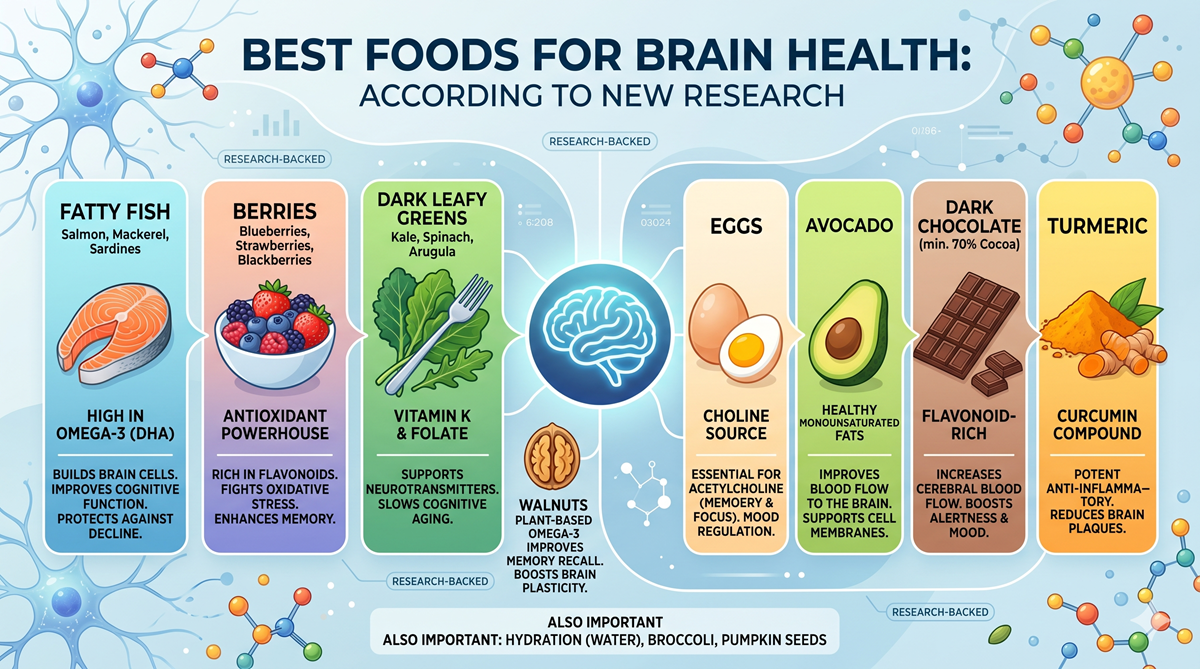
If there is one food that consistently rises to the top across research institutions, it is fatty fish. Wild salmon, sardines, mackerel, sablefish, and halibut are rich in EPA and DHA — the omega-3 fatty acids that the brain is literally built from. Studies show that eating just one seafood meal per week is associated with a significantly reduced risk of both Alzheimer’s disease and dementia. Omega-3s help generate new neurons, combat neuroinflammation, and may even assist in clearing amyloid plaques from the brain — a hallmark feature of Alzheimer’s. A study in Nature Aging identified fatty acids from seafood as one of the top blood biomarkers associated with slower brain aging in adults aged 65 to 75.
2. Leafy Greens, Berries, and Eggs: The Everyday Trio
Leafy greens — kale, spinach, collards, and broccoli — are dense in vitamin K, lutein, folate, and beta-carotene, all of which support cognitive longevity. A landmark Rush University study found that people who regularly ate leafy greens had cognitive abilities equivalent to being 11 years younger than those who avoided them. Berries, particularly blueberries, are high in anthocyanins, which improve blood flow to the brain, enhance neuron communication, and may delay age-related memory decline. Research shows that blueberry consumption measurably improves memory and protects against neurodegenerative disease. Eggs round out this trio as one of the best dietary sources of choline — a nutrient critical for producing acetylcholine, the neurotransmitter central to memory and learning. Many people do not consume nearly enough choline, making eggs a particularly strategic brain food.
3. Nuts, Dark Chocolate, and Coffee: Surprising Brain Allies
Walnuts are exceptional even among nuts, containing ALA — a plant-based omega-3 fatty acid. A UCLA study linked higher walnut consumption to improved cognitive test scores, and research consistently shows nut consumption supports memory and mental flexibility. Dark chocolate (70% cacao or higher) contains flavonoids, caffeine, and antioxidants that improve blood flow to the brain and may slow age-related mental decline. For coffee and tea lovers, a February 2026 study tracking participants over 40 years found that consuming two to three cups of caffeinated coffee or tea per day was associated with a meaningfully lower rate of dementia. Importantly, decaffeinated options did not show the same benefits — the caffeine itself appears to play a role in the protective effect.
🧠 Key Points: Best Foods for Brain Health According to New Research
- Fatty fish like wild salmon and sardines are the #1 brain food, with omega-3s directly linked to slower cognitive aging in multiple new studies.
- Leafy greens consumed regularly have been associated with cognitive function equivalent to being 11 years younger, according to Rush University researchers.
- Blueberries improve neuron communication, boost memory, and contain anthocyanins that actively protect against age-related brain decline.
- A February 2026 study found that 2–3 cups of caffeinated coffee or tea per day over 40 years was linked to significantly lower dementia rates.
- The MIND diet — combining Mediterranean and DASH eating principles — remains the most research-backed dietary pattern for overall cognitive health.
Impact & Analysis: What This Means for Your Long-Term Brain Health
The implications of this growing body of research are significant. In the short term, incorporating brain-healthy foods can improve focus, mood stability, and working memory — benefits that many people notice within weeks of dietary changes. Over the long term, the stakes are even higher: consistent dietary habits begun in midlife appear to substantially reduce the risk of Alzheimer’s and other forms of dementia in later decades.
For healthcare systems globally, these findings represent a major opportunity. If diet can prevent even a fraction of projected dementia cases, the human and economic toll of the disease could be meaningfully reduced. For individuals, the research underscores that it is never too early — or too late — to start eating in ways that protect cognitive function.
Nutritionists emphasize that no single food is a magic bullet. The most protective approach is an overall dietary pattern — rich in vegetables, fruits, fish, nuts, and whole grains — rather than relying on any one item. Small, consistent daily choices accumulate into powerful long-term results for brain health.
People Are Also Asking
❓ What is the single best food for brain health?
Most nutrition researchers and dietitians point to fatty fish as the top food for brain health. Fish like wild salmon, sardines, and mackerel are the richest dietary sources of EPA and DHA omega-3 fatty acids, which the brain is structurally built from. Studies show that eating seafood just once per week is linked to meaningfully lower rates of Alzheimer’s and dementia.
❓ Can what I eat really prevent dementia?
Research increasingly suggests that diet is one of the most powerful modifiable risk factors for dementia. Current estimates indicate that up to 40% of dementia cases may be attributable to preventable factors, with diet among the most influential. While no diet can guarantee prevention, consistently eating a brain-healthy pattern — such as the MIND diet — significantly reduces risk over time.
❓ Is coffee actually good for the brain?
Yes, according to a February 2026 study that tracked participants over 40 years. Those who drank two to three cups of caffeinated coffee or tea per day showed meaningfully lower rates of dementia. Importantly, decaffeinated coffee did not show the same benefits, suggesting that caffeine itself — in moderate amounts — plays a key role in the protective effect.
❓ What is the MIND diet and does it work?
The MIND diet is a hybrid of the Mediterranean diet and the DASH diet, specifically developed with brain health as a primary goal. It emphasizes leafy greens, berries, fish, nuts, olive oil, and whole grains, while limiting red meat, fried food, sweets, and processed products. Research shows it is associated with a significantly slower rate of cognitive decline compared to standard Western eating patterns.
Conclusion
The science is clear: the best foods for brain health according to new research are not exotic or expensive — they are foods that have been part of traditional healthy diets for generations. Fatty fish, leafy greens, berries, eggs, walnuts, and even a daily cup of coffee all carry measurable benefits for cognitive function and long-term brain protection.
What matters most is consistency. No single meal changes your brain overnight, but a sustained pattern of eating that prioritizes these foods — and limits ultra-processed alternatives — creates compound benefits that accumulate over years and decades. Think of every meal as an opportunity to invest in your future cognitive health.
Start with one change: add salmon twice a week, swap chips for walnuts, or throw a handful of blueberries into your morning routine. Your brain will thank you for it. Found this article helpful? Share it with someone who cares about staying sharp for the long haul.
This article is for informational purposes only and does not constitute medical or nutritional advice. Always consult a qualified healthcare professional before making significant changes to your diet.
Sources: Houston Methodist (February 2026), Nature Aging, Rush University, Harvard Health Publishing, Cleveland Clinic, Science News Today (October 2025), Fisher Center for Alzheimer’s Research Foundation.
Related Internal Links
- SpaceX IPO 2026: Everything You Need to Know on June
- New Weight Loss Study 2026: What Scientists Found
- FIFA World Cup 2026 Team Predictions: Who Will Win?
- Hero Up Reviews 2026: Honest Warnings and Results Exposed