New Weight Loss Study 2026: What Scientists Found
New Weight Loss Study 2026: What Scientists Found — And Why It Changes Everything
| Label | Value |
|---|---|
| What Happened | Multiple landmark weight loss studies published in 2026, covering new drugs, lifestyle habits, and brain science |
| When | April–May 2026 |
| Where | Indiana University, NIH, European Congress on Obesity (Istanbul), Eli Lilly research labs |
| Who | Researchers at IU, NIH, Eli Lilly, American Psychological Association, and international obesity experts |
| Why It Matters | These breakthroughs could reshape how doctors treat obesity and how individuals approach weight management |
| Source | Molecular Metabolism, Nature Metabolism, International Journal of Environmental Research and Public Health, Health Psychology |
Introduction
If you’ve been following the science of weight loss, 2026 is shaping up to be one of the most important years on record. A wave of new weight loss studies in 2026 has uncovered findings that scientists say could fundamentally change how we understand and treat obesity. From an experimental drug that produces weight loss comparable to bariatric surgery, to a surprisingly simple daily walking target that stops the pounds from coming back — the research landing this year is both practical and profound.
This article breaks down the most significant discoveries in plain language. Whether you’re managing your own weight, caring for a family member, or just curious about where medicine is headed, here’s what the latest science reveals — and what it means for you.
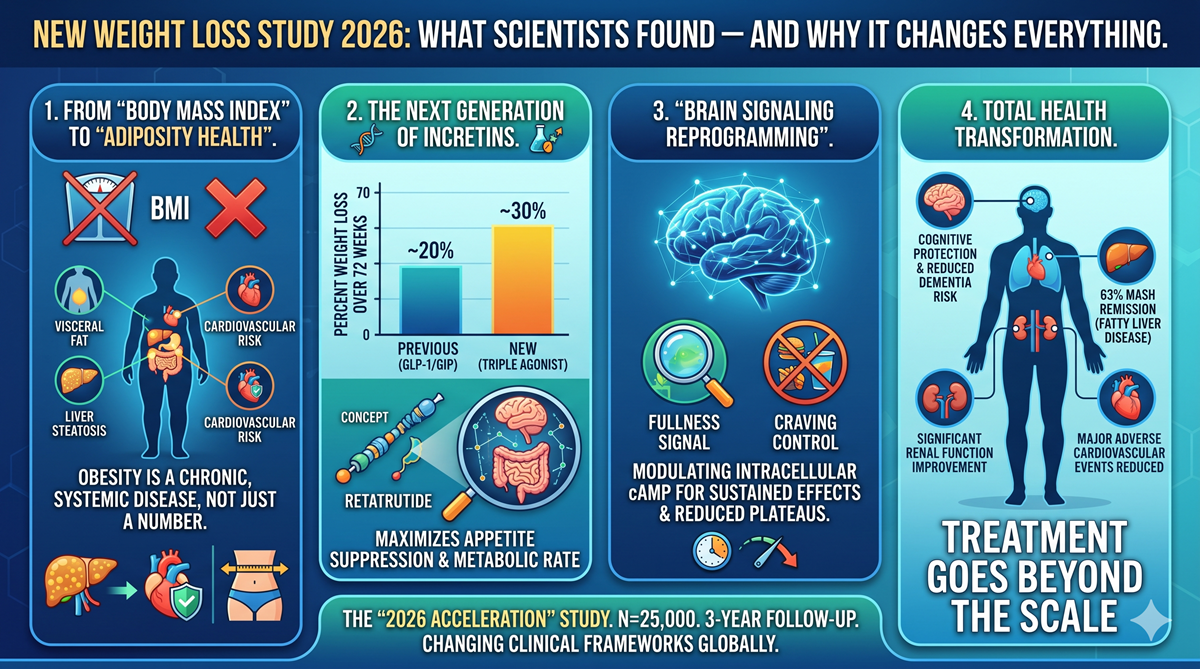
Background: Why Weight Loss Science Is Moving So Fast
For decades, the standard advice for losing weight was simple: eat less and move more. But as obesity rates continued rising globally — now affecting more than one billion people worldwide — researchers began digging deeper into the biology behind why the body resists weight loss and how it can be overcome more effectively.
The arrival of GLP-1 receptor agonist drugs like Ozempic and Wegovy changed the conversation dramatically. These medications, which work by mimicking gut hormones that suppress appetite, proved far more effective than previous treatments. But they also came with significant side effects and high costs, pushing scientists to look beyond them.
Now in 2026, that search has accelerated. New studies are challenging old assumptions about which hormones matter, which habits are most effective for long-term success, and even what happens inside the brain when someone loses weight. The pace of discovery has been remarkable — and the public is paying close attention.
What the New Weight Loss Studies in 2026 Actually Found
1. Eli Lilly’s Retatrutide: Weight Loss That Rivals Surgery
Perhaps the most headline-grabbing finding of 2026 came from research into Eli Lilly’s experimental drug retatrutide. Published in May 2026, the study found that participants lost an average of 28% of their total body weight over 80 weeks — a figure that puts the drug in the same league as bariatric surgery, which has long been considered the gold standard for severe obesity treatment.
Retatrutide works by targeting three hormone systems simultaneously — GLP-1, GIP, and glucagon — rather than just one. Participants in the trial also saw meaningful improvements in cardiometabolic health markers including blood pressure, blood sugar, and cholesterol. The drug is not yet available to the public; it awaits FDA approval, which researchers expect could come as early as 2027.
2. You Might Not Need GLP-1 After All
In a separate study published in Molecular Metabolism in April 2026, researchers from Indiana University and Ludwig Maximilian University of Munich made a striking discovery: effective weight loss may not require GLP-1 hormone activity at all. Scientists Richard DiMarchi and Matthias Tschöp — whose earlier work helped lay the groundwork for drugs like Wegovy and Zepbound — found that in advanced triple-hormone peptide formulations, removing the GLP-1 component still preserved full weight-loss benefits.
The implication is significant. GLP-1 drugs are effective but cause gastrointestinal side effects that lead many patients to stop treatment. If next-generation drugs can achieve the same results without GLP-1, they could be better tolerated and more accessible to a wider group of patients.
3. The 8,500-Step Secret to Keeping Weight Off
Not all the breakthroughs of 2026 involve expensive pharmaceuticals. A major international study presented at the European Congress on Obesity in Istanbul in May 2026 found that walking approximately 8,500 steps per day during and after a weight-loss program dramatically reduced the risk of regaining lost weight. Researchers observed that people who maintained this step count through a behavioral lifestyle program were far more successful at long-term weight maintenance than those who did not.
The study is particularly relevant because weight regain remains one of the biggest challenges in obesity treatment — most people regain a significant portion of lost weight within two to five years. Professor El Ghoch, one of the lead researchers, described 8,500 steps as a practical, affordable, and highly accessible target that healthcare providers should actively promote as part of any weight-management program.
Alongside this, NIH researchers published findings in Nature Metabolism explaining at a cellular level why GLP-1 drugs like Ozempic eventually plateau in their effectiveness — identifying internal brain-cell signaling differences that explain why results vary so widely between individuals and tend to slow over time.
🔑 Key Points
- Eli Lilly’s experimental drug retatrutide produced an average 28% body weight loss over 80 weeks in clinical trials — results comparable to bariatric surgery.
- Indiana University researchers found that GLP-1 hormone activity may not be essential in next-generation weight-loss drugs, potentially reducing common side effects.
- Walking 8,500 steps per day during and after a weight-loss program significantly reduces the risk of regaining lost weight, according to a major 2026 international study.
- NIH scientists have uncovered why Ozempic and Wegovy plateau over time, revealing key differences in how individual brain cells respond to these medications.
- Consistency in eating habits — keeping meals similar day to day — was linked to better weight loss outcomes than dietary variety, per American Psychological Association research.
Impact & Analysis: What This Means Going Forward
Taken together, the new weight loss studies of 2026 point toward a future where treatment is far more personalized, effective, and accessible than today. In the short term, the biggest shift will likely come from pharmaceutical advances. If retatrutide receives FDA approval in 2027 as expected, it will introduce a new standard of care for severe obesity — one that could reach people for whom current GLP-1 drugs are either ineffective or intolerable.
For the broader population, the lifestyle findings are equally significant. The 8,500-step research offers a concrete, free, and immediately actionable target for anyone trying to maintain a healthier weight. Combined with the APA findings on consistent eating habits, the 2026 research makes a strong case that long-term weight management is less about dramatic diets and more about building sustainable daily routines.
The longer-term picture is about unlocking the brain’s role in weight regulation. As NIH and other researchers continue mapping how neurons respond to hormones and medications, the next decade could produce treatments that are not only more effective but also far better tailored to individual biology.
People Are Also Asking
❓ What is retatrutide and when will it be available?
Retatrutide is an experimental weight-loss drug developed by Eli Lilly that targets three hormone systems — GLP-1, GIP, and glucagon — simultaneously. In a 2026 clinical study, participants lost an average of 28% of their body weight over 80 weeks. The drug has not yet received FDA approval and is expected to go through the regulatory process with a possible approval in 2027.
❓ Why do weight-loss drugs like Ozempic stop working over time?
Research from the NIH published in 2026 revealed that it comes down to differences in how individual brain cells respond to GLP-1 medications at the molecular level. The internal signaling pathways inside neurons targeted by these drugs appear to adapt over time, reducing the medication’s appetite-suppressing effect. This explains why many users experience a plateau after initial weight loss.
❓ How many steps do I need to walk daily to maintain weight loss?
According to a major study presented at the European Congress on Obesity in May 2026, walking around 8,500 steps per day — both during and after a weight-loss program — significantly reduces the chance of regaining lost weight. This is slightly above the popular 10,000-step benchmark but focuses specifically on the level needed to support long-term weight maintenance rather than general fitness.
❓ Do you still need GLP-1 in weight-loss drugs for them to work?
According to groundbreaking research published in Molecular Metabolism in April 2026, the answer may be no. Scientists at Indiana University found that when GLP-1 activity was removed from triple-hormone peptide formulations, weight-loss benefits were maintained through the activity of glucagon and GIP hormones alone. This discovery opens the door to future treatments with fewer gastrointestinal side effects.
Conclusion
The new weight loss studies of 2026 make one thing abundantly clear: science is moving faster than most people realize. From a potential surgery-level drug to the revelation that 8,500 daily steps could be a key to keeping weight off, the findings this year offer both high-tech solutions and practical everyday strategies.
What’s especially encouraging is that the research covers all angles — pharmaceutical breakthroughs for those with severe obesity, brain-science discoveries that explain why current treatments fall short, and accessible lifestyle habits backed by solid data. Whether you’re waiting for the next generation of medications or looking for something you can start today, 2026’s science has something relevant to offer.
If you found this article useful, consider sharing it with someone who is on their own weight-management journey. And if you have thoughts or questions about the research covered here, drop them in the comments — the conversation around weight science is one worth having.
Disclaimer: This article is for informational purposes only and does not constitute medical advice. Always consult a qualified healthcare professional before starting any weight-loss program, medication, or dietary change.
Sources: Molecular Metabolism (April 2026); Nature Metabolism (May 2026); European Congress on Obesity 2026, Istanbul; International Journal of Environmental Research and Public Health; Health Psychology (American Psychological Association); Deseret News / Eli Lilly clinical trial data (May 2026).
Related Internal Links
- FIFA World Cup 2026 Team Predictions: Who Will Win?
- Best Foods for Brain Health According to New Research 2026
- Gold Price Forecast 2026: Should You Invest Now?
- US Economy Update June 2026: Growth, Jobs & Inflation