| Label | Value |
|---|---|
| Topic | Lenovo FY2026 Full-Year & Q4 Earnings Report |
| Key Figures | $83.1B full-year revenue; AI revenue up 105% YoY; Q4 revenue $21.6B (+27% YoY) |
| Who It Affects | Investors, tech industry, enterprise IT buyers, PC market watchers |
| Time Period | Fiscal Year ended March 31, 2026; Results announced May 22, 2026 |
| Bottom Line | Lenovo’s AI pivot is paying off — record revenue and surging profits signal the company is riding the AI hardware wave to new heights. |
Introduction
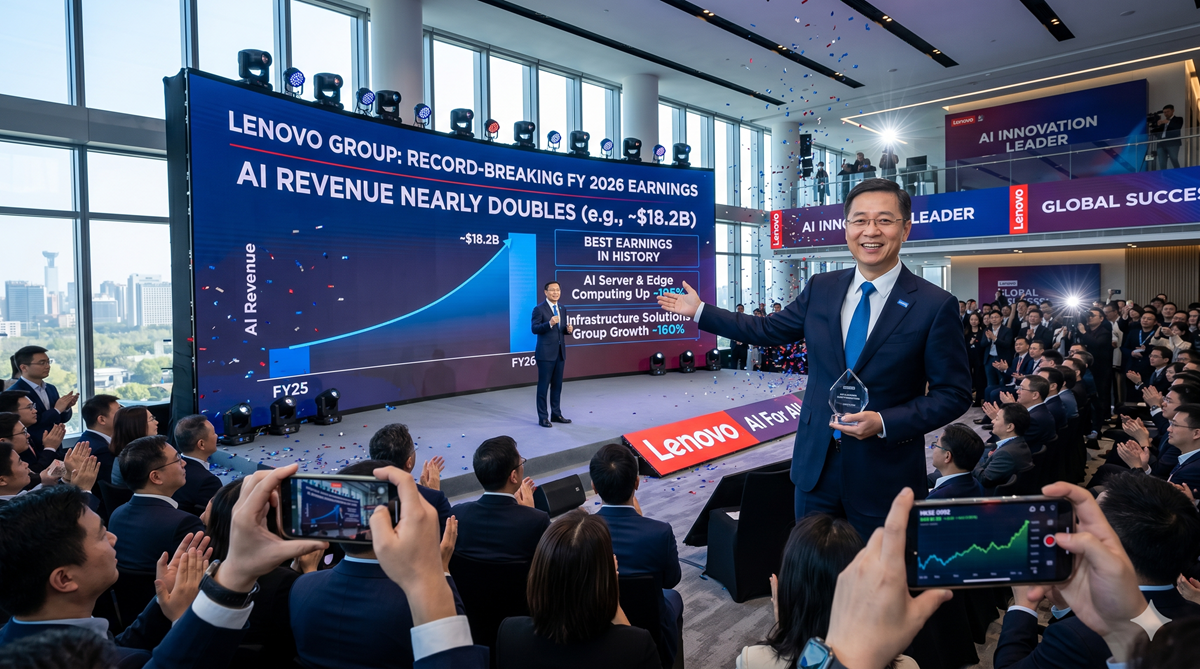
Lenovo AI revenue 2026 has become the defining story in the global technology sector this month. The Chinese PC and infrastructure giant reported its strongest financial results ever on May 22, 2026, capping a fiscal year that saw the company transform from a hardware manufacturer into a serious artificial intelligence powerhouse. Full-year group revenue reached a record $83.1 billion, and AI-related sales more than doubled compared to the previous year — a performance that sent Lenovo’s Hong Kong-listed shares surging more than 15% in a single session.
The results matter far beyond Lenovo’s own balance sheet. They signal that AI is no longer a niche premium category — it is rapidly becoming the core driver of revenue for one of the world’s most diversified technology companies. For investors, enterprise IT buyers, and anyone tracking the next wave of computing, these numbers deserve close attention.
Background & Context
Lenovo has spent the better part of three years repositioning itself around what CEO Yuanqing Yang calls a “Hybrid AI” strategy — pushing artificial intelligence capabilities into devices, data center infrastructure, and professional services simultaneously. The company holds the top position among global PC makers, a title it has defended for over a decade, but management recognized early that simply shipping more laptops would not sustain the growth trajectory investors expected.
The strategy accelerated sharply during fiscal 2025/26. Enterprises began replacing aging Windows 10 fleets with new AI-capable hardware ahead of end-of-life deadlines. Demand for GPU-powered servers exploded as cloud providers and enterprises scrambled to build AI inference capacity. At the same time, Motorola — Lenovo’s smartphone brand — posted record shipments, adding another growth pillar. By the time the fiscal year closed on March 31, 2026, every major business unit was growing at double-digit rates simultaneously, a feat the company had not achieved in years.
Breaking Down the Record Results
Full-Year Revenue and Profitability
For the fiscal year ended March 31, 2026, Lenovo posted total group revenue of $83.1 billion — the highest annual figure in the company’s history. Adjusted net income for the year climbed 42% year-on-year to reach $2 billion, reflecting not just top-line growth but improving operational efficiency across the business. AI-related revenue, which Lenovo defines as covering neural processing unit-equipped PCs and smartphones, GPU-powered servers, and a range of AI-specific services, grew 105% for the full year and accounted for 33% of total group revenue.
The fourth quarter alone illustrated just how fast the shift is happening. Q4 revenue hit $21.6 billion, up 27% year-on-year — the fastest quarterly growth pace the company had recorded in five years, and well ahead of Wall Street’s consensus estimate of $19.19 billion. Within that quarter, AI-related revenue surged 84% and made up 38% of total revenue, suggesting the mix is still moving in Lenovo’s favor.
Business Group Performance
All three of Lenovo’s major operating units contributed to the record performance. The Intelligent Devices Group, which houses PC and smartphone hardware, generated $58.9 billion in full-year revenue, up 17% year-on-year. Lenovo held a 24.4% global PC market share in Q4 — a quarterly record — and widened its lead over the second-place vendor to the widest margin in 15 years. Premium AI-capable laptops equipped with dedicated neural processing units accounted for 50% of total PC shipments in the quarter, up sharply from prior periods, driving meaningful gains in average selling prices.
The Infrastructure Solutions Group, which covers servers and data center hardware, saw Q4 revenue grow 37% year-on-year to $5.63 billion, returning to full-year profitability. The group reported a pipeline of AI server deals worth approximately $21 billion, a figure that underscores the depth of enterprise demand. Lenovo’s Neptune liquid-cooling technology — essential for dense AI server racks — posted 300% revenue growth year-on-year in earlier quarters as hyperscale and cloud customers expanded deployments. The Solutions and Services Group crossed the $10 billion annual revenue threshold for the first time, growing 19% year-on-year with an operating margin above 22%, making it the group’s most profitable segment on a margin basis.
Market Reaction and the Road to $100 Billion
Investors responded decisively to the results. Lenovo’s Hong Kong-listed shares climbed as much as 19.32% on the day of the announcement, and with shares already up more than 60% for the calendar year to date, the company has become one of the standout performers in the global technology sector in 2026. Chairman and CEO Yuanqing Yang used the post-earnings period to set an ambitious public target: reaching $100 billion in annual revenue within two years. In an interview with Bloomberg, Yang tied the goal directly to the company’s AI positioning, stating that Lenovo’s hybrid AI vision places it at the forefront of AI inferencing and democratization. Analysts note the target is ambitious but achievable if AI hardware demand and premium PC pricing continue on their current trajectory.
📌 Key Points
- Lenovo reported record full-year revenue of $83.1 billion for FY2026, the highest in the company’s history.
- AI-related revenue nearly doubled, growing 105% for the full year and accounting for 33% of total group revenue.
- Q4 revenue reached $21.6 billion, up 27% year-on-year — the fastest quarterly growth rate in five years — beating Wall Street estimates by over $2 billion.
- The Solutions and Services Group crossed $10 billion in annual revenue for the first time, with an operating margin exceeding 22%.
- CEO Yuanqing Yang set a goal of reaching $100 billion in annual revenue within two years, anchored by the company’s Hybrid AI strategy.
Impact & Analysis
The implications of Lenovo’s results extend well beyond a single company’s quarterly report. For enterprise IT buyers, the results confirm that the market for AI-capable hardware is scaling rapidly, which is likely to sustain competitive pricing pressure and accelerate product refresh cycles. Organizations still running conventional laptop and server fleets will face growing performance gaps versus peers who have already adopted AI-equipped hardware.
For investors and market observers, Lenovo’s performance positions the company alongside chipmakers and cloud data center operators as a primary beneficiary of the AI infrastructure buildout. The Infrastructure Solutions Group’s return to full-year profitability, combined with a reported $21 billion server pipeline, suggests sustained near-term revenue visibility. In the short term, component cost pressures — particularly in DRAM and high-bandwidth memory — remain a headwind that management has acknowledged. Over the longer term, however, if the Hybrid AI strategy continues to push AI capabilities into Lenovo’s entire product portfolio, the company’s revenue mix should improve further, supporting both top-line growth and margin expansion well into fiscal 2027 and beyond.
People Are Also Asking
Conclusion
Lenovo’s fiscal year 2026 results represent a clear inflection point. The company has successfully converted years of AI investment into measurable, record-breaking financial performance — with AI-related revenue nearly doubling, total revenue hitting $83.1 billion, and every major business unit growing simultaneously. The stock market’s enthusiastic response underscores how rare this kind of broad-based, AI-driven growth is among large-cap technology companies.
Whether Lenovo can sustain this trajectory toward the $100 billion target will depend on continued enterprise AI infrastructure demand, its ability to manage component cost pressures, and its capacity to deepen its premium device mix. For now, the numbers make a compelling case that Lenovo’s Hybrid AI bet is paying off. If you found this analysis useful, share it with a colleague or leave a comment below — we’d love to hear your take on where AI hardware is headed next.
This article is for informational purposes only and does not constitute financial or investment advice. Readers should conduct their own research before making investment decisions.
Sources: Lenovo Group Limited press release (May 22, 2026); CNBC Africa; Yahoo Finance; Futurum Research; TechTimes; FX Leaders; Let’s Data Science.
Related Internal Links
- SpaceX IPO 2026: Everything You Need to Know on June
- New Weight Loss Study 2026: What Scientists Found
- FIFA World Cup 2026 Team Predictions: Who Will Win?
- Best Foods for Brain Health According to New Research 2026